
ACC Projects
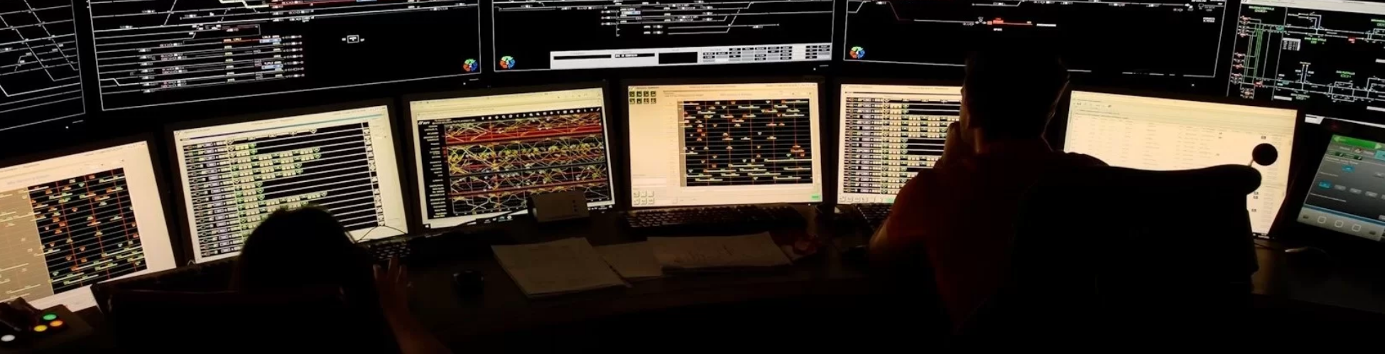
ACC is a set of projects, part of the Strategic Program for Railways research, carried out in collaboration with Rete Ferroviaria Italiana (RFI).
ACC is meant to provide domain experts of RFI a structured methodology and a set of usable tools to support the design, traceability, verification and deployment of railways interlocking control systems.
Project details
ACC (“Apparati Centrali Computerizzati”) are computer based railways
interlocking control systems.
Railway interlocking systems are
safety-critical mechanisms that manage and control train movements across
complex track layouts, such as junctions and crossings, to prevent collisions
and ensure safe operations. Interlocking systems coordinate signals, points
(switches), and other track-based devices so that trains can only proceed when
routes are clear and no conflicting movements are possible. They can be
mechanical, electrical, or computerized, each employing logical rules to lock
specific routes or signals while others are in use. Modern interlocking systems
are largely computer-based, allowing for centralized control and integration
with automated signaling, enhancing efficiency and safety across railway
networks.
Since 2018 FBK has collaborated with RFI within the scope of several projects
for a model-based approach to the design, verification and deployment of railway
interlocking systems.
In the proposed approach, the flow starts from a set
of specifications in Controlled Natural Language (CNL), that are close to the
jargon adopted by domain experts, but fully formal. From the CNL, a complete
SysML specification is extracted, leveraging various forms of diagrams, and
enabling automated code generation. To support the verification process of the
interlocking logics, several formal verification methods are supported. A
complementary part of the flow supports the extraction of formal properties from
legacy interlocking systems designed as relay circuits.
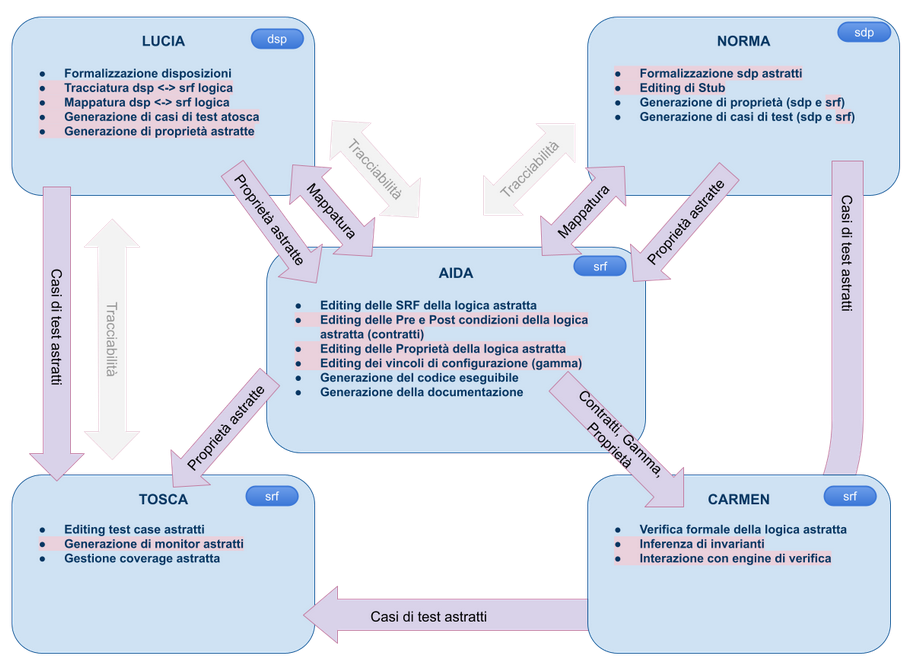
The design and verification process is supported by a comprehensive set of software tools ("OPERA") that have been developed specifically in the scope of the projects. All the tools are based on the Eclipse platform.
-
LUCIA for the formalization of the textual dispositions and regulatory. LUCIA can generate test cases and properties out of the formalized documents.
-
NORMA for the formalization of the legacy relay circuits of the logic. NORMA provides syntactic and semantic checkers of the modeled circuits, and automatically generates test cases and properties with the use of formal method techniques.
-
AIDA for the design of the logic of the interlocking system, automatic translation into SysML models, the generation of executable code and other artifacts like documentation, the execution of test cases and debugging sessions on the generated code in closed loop with a simulator of trains and station devices.
-
TOSCA for the verification by testing and test case generation.
-
CARMEN to support the specification of properties and their verification through formal verification techniques as a complementary approach to testing-based verification.
The tools fully support the flow and are currently used by railway experts
to design, verify and deploy several operative systems.
General Info
With a overall budget of ~2.8 M€, ACC is a set of projects started in 2017 and continuing today. Namely, ACC is split into several sequential projects:
- ACC0: 2017 (3 months)
- Preliminary assessment, requirements elicitation, project preparation
- ACC1: 2018-2019 (21 months)
- Setup methodology
- Development of AIDA, NORMA, TOSCA
- ACC2-Toolset: 2022/12 - 2024/04 (16 months)
- AIDA: extensions to the logic specification language
- AIDA: profiling and optimization of generated code
- ACC2-Verifica: 2024/04 - 2025/04
- LUCIA: methodology and prototype development
- NORMA: development of algorithms for the analysis of the legacy relay circuits
- CARMEN: methodology and prototype development
- TOSCA: extensions of the provided features
- ACC3-OPERA: 2025/12 - 2028/06 (30 months)
- Industrialization and integration of the OPERA toolset.
- Scaling up CARMEN to apply formal verification to the large systems.
- Implementation of several new features in all tools.
Start Date: Sep 2018
End Date: Jun 2028
Budget: 2.8 M€